TCP and UDP - the building blocks of the internet
There are two main protocols the internet is based on, TCP (Transmission Control Protocol) and UDP (User Datagram Protocol) These are both layer 4 protocols.
TCP - Transmission Control Protocol
TCP is the most widely used protocol. A lot of other protocols are based on it, including HTTP. Key points:
- Connection-oriented – Establishes a connection before data transfer (via a three-way handshake:
- SYN (Synchronize) – Client sends a SYN packet to request a connection.
- SYN-ACK (Synchronize-Acknowledge) – Server responds with SYN-ACK to acknowledge the request.
- ACK (Acknowledge) – Client sends an ACK to confirm the connection is established.
- Reliable – Ensures all data is received in the correct order with retransmissions if packets are lost.
- Error checking – Uses checksums and acknowledgments to verify data integrity.
- Flow control – Adjusts data transmission speed based on network conditions.
TCP is used when you need a reliable connectivity without any packet loss.
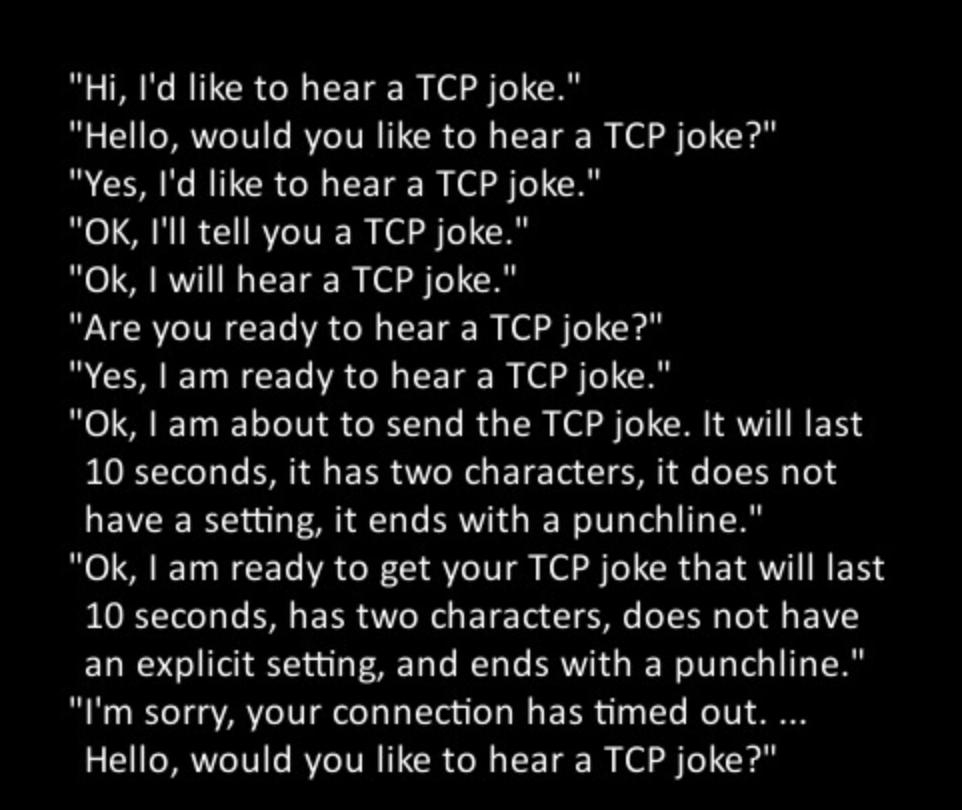
If humans spoke with each-other following the TCP rules, it would look something like this:
What protocols do I use that are TCP based?
- HTTP/S - Web browsing
- SMTP, IMAP, POP3 - Email
- FTP - File Transfer protocol
- SSH - Remote access
UDP - User Datagram Protocol
Key points:
- Connectionless – No handshake; data is sent without establishing a connection.
- Fast but unreliable – No retransmissions or guaranteed order of delivery.
- Minimal overhead – Less processing and lower latency.
UDP is mainly used when speed and simplicity are prioritised over reliability, like Live Streaming (VoIP, video, online gaming). Video streaming services like Netflix will not use UDP as they have reliability as a requirement.