Java Introduction
How to write Java?
Let’s look at a basic Java application:
package com.kalschatzi;

public class Main {
    public static void main(String args[]) {
        System.out.println("Hello, world");
    }
}
This will be the simplest Java application you can write. Here’s how your folder structure should look like:
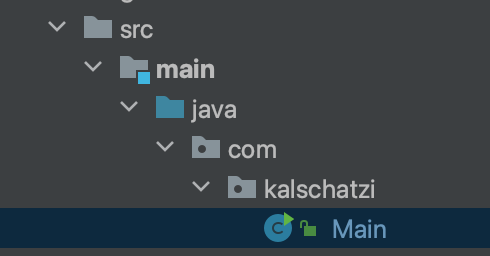
Let’s deconstruct it line by line.
package com.kalschatzi;This is where package is, which is what Java calls code folders. If you look at the file structure image, you’ll see that it matches.
Why does it matter? More details will come on this later, but it’s a way to organize the code and ensure only certain other files have access to the correct code. There are plenty of approaches, and different developers might have different preferences, but you can study Domain Driven Development - DDD in case you’re curious.
Next we define our class
public class Main {Here we have the class definition. With the public we’re starting to talk about encapsulation. This defines from where this class is accessible. As a root class, you can only have public or package-private access. The key difference is that you will not be allowed to create a new instance of a package-private class outside of that package.
You can also have a private class, but only as an inner class. Don’t worry about any of these concepts for now, it can be something you revisit later.
What’s a class?
A class is a blueprint for creating objects. It contains fields (variables) and methods that define the behavior of the objects. By having it you can create a new instance of that class that will represent the object. For example:
public class Animal {
    private final String name;
    ...
In here you define that you have an animal, and that animal has a name. Then you can create a new Animal object.
Animal animalKali = new Animal("Kali");Here I’ve created an animal named Kali. I can create as many as I want with as many names as I want.
We’ll deconstruct that class later.
Moving on to the next line we have
    public static void main(String args[]) {
        if (args.length > 0) {
            System.out.println("Hello " + args[0]);
        } else  {
            System.out.println("Hello world");
        }
    }
All Java applications require this method in their Main class. It’s the entrypoint and needs to be there.
What do all these keywords mean?
This a public function that is static (that can be used without creating a new instance), has no return or void return, it’s called main and receives a list of arguments. These arguments are parameters passed when executing the application, for example:
javac Main.java  # Compile
java Main Tiago
This will print Hello Tiago as that’s what I passed on the args.
And with this we have a working Java application 🎉