HashMap Deep Dive
A HashMap is an implementation of the Map interface in Java that stores key-value pairs. It provides efficient O(1) average-time complexity for operations like insert, delete, and search. However, its performance can degrade under certain circumstances, leading to the worst-case time complexity of O(n).
How HashMap works
Hash Function
A HashMap uses a hash function to compute an index (called a bucket) where the key-value pair will be stored. The hash function takes the key, processes it, and returns an integer index. The goal of a good hash function is to evenly distribute the keys across the available buckets to minimize collisions.
Buckets
Internally, a HashMap uses an array of buckets (or slots). Each bucket can store multiple key-value pairs in case of collisions (i.e., two keys having the same hash code). When inserting or searching for a key, the hash function maps the key to a specific bucket.
Collisions
Collisions occur when two or more keys have the same hash code and thus map to the same bucket. There are two main ways to handle collisions:
- Chaining: Each bucket holds a linked list (or other data structure) of entries that have the same hash code. When a collision occurs, the new entry is added to the list in the bucket
- Open Addressing: When a collision occurs, the algorithm searches for the next available slot in the array to place the key-value pair.
Resizing
As elements are added, the HashMap’s internal array may need to grow. Typically, when the load factor (the number of elements divided by the number of buckets) exceeds a threshold (commonly 0.75), the HashMap resizes its array, usually doubling its size and rehashing the elements to new buckets.
Average Case vs Worst Case
In the average case, if the hash function distributes keys evenly across the buckets, each bucket will hold only a few entries. Therefore, search, insert, and delete operations will take O(1) time, making HashMap very efficient. The worst-case time complexity for a search in a HashMap is O(n), which occurs when many keys hash to the same bucket (i.e., collisions). In this case, all the key-value pairs in that bucket will be stored in a linked list (or other data structure). If all keys hash to the same bucket, the entire HashMap becomes a linked list, and the search operation would need to traverse all elements in the list, resulting in O(n) time complexity.
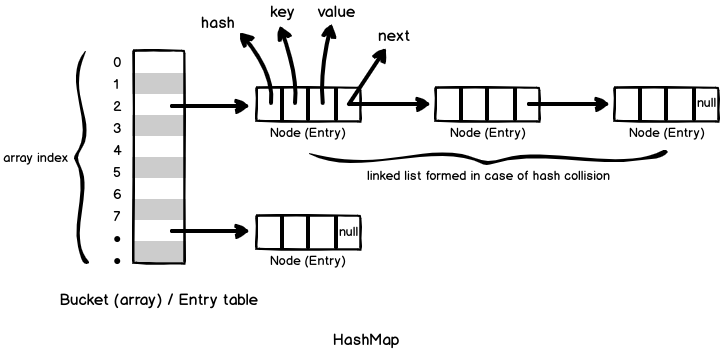
This is a classic image of a HashMap and you’ll see this in some technical interviews, where you’ll be shown a similar image and asked to explain what it means.